
We document the dark times in our past so that later generations will know what happened. How else can we ensure they won’t happen again?
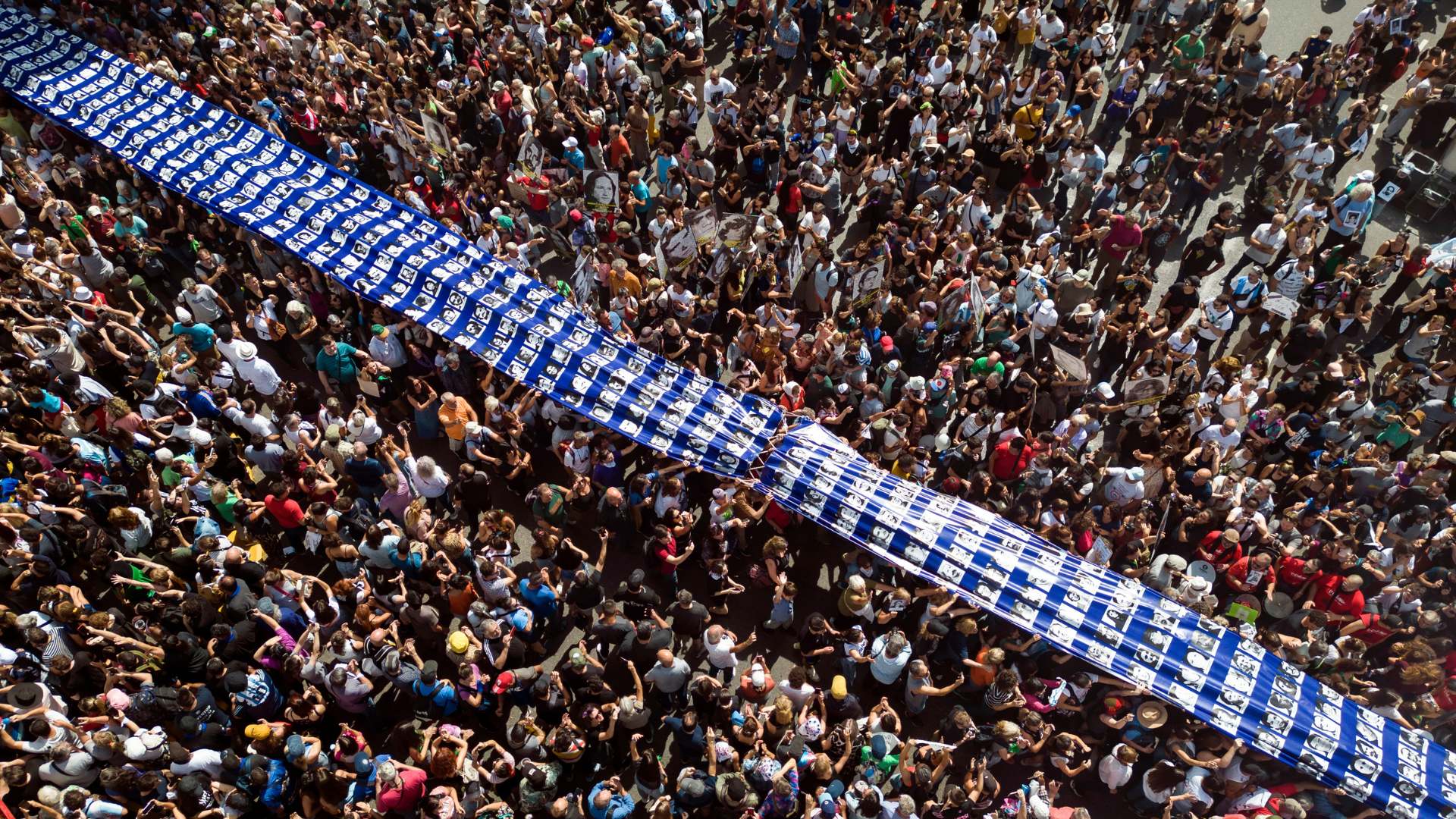
Demonstrators carry a banner with photos of people who disappeared during the 1976-1983 military dictatorship in a march commemorating the 48th anniversary of the coup in Buenos Aires, Argentina, 24 March 2024. (AP Photo/Rodrigo Abd)
In 2023, Argentina elected a far-right Libertarian party with Javier Milei serving as the president. Known as El Loco (“the Madman”), Milei is notorious for his conservative stance on social issues and as a skeptic of Argentina’s well-documented past. His vice president, Victoria Villarruel, is the niece, daughter and granddaughter of former officers from a brutal military dictatorship.
During the Argentine military junta from 1973 to 1983, tens of thousands of people were forcibly “disappeared” for speaking out against the regime. They are known as “Los desaparecidos.” Across the nation, hundreds of concentration camps were set up to imprison, torture and kill dissidents of the dictatorship.
Publicly, the Argentinian government has cast doubt on the established narrative of the military dictatorship, including the number of los desaparecidos and the severity of the state’s crimes.
For example, last year Milei’s government defunded the ESMA Museum and Site of Memory, a former clandestine detention center located in the ex-Navy School of Mechanics in Buenos Aires, now a museum dedicated to the disappeared and UNESCO World Heritage Site. The administration has also threatened to close memorial sites, audit the records of human rights organizations and reopen cases against leftist guerilla fighters.
In order to understand the significance of the rhetoric and actions of Milei’s government in regard to Argentina’s past, I spoke with News Decoder Correspondent Enrique Shore. He served as the official photographer for Argentina’s National Commission on the Disappearance of Persons (CONADEP), a decentralized body established only five days after the fall of the dictatorship.
Shore visited dozens of clandestine detention centers, photographing evidence and interviewing witnesses to extensively document and investigate the forced disappearance of thousands of people.
The work of CONADEP led to the conviction of members of the military junta and even the discovery and identification of victims who disappeared.
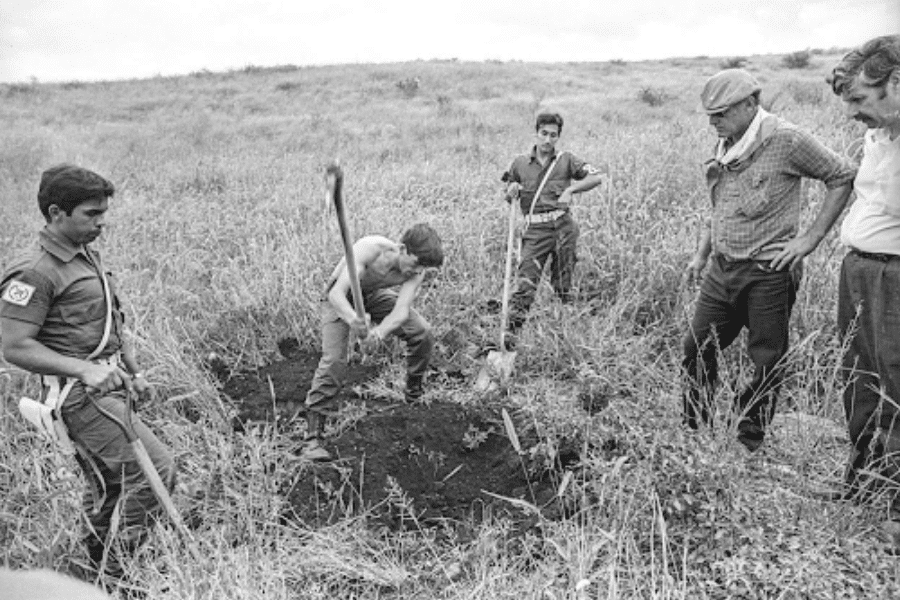
Argentine investigators dig for missing bodies at the La Perla military compound in March 1984. (Credit: Enrique Shore)
Just before I finished my conversation with Shore, he asked if he could share the story of the one case where investigators came up empty-handed.
Located in northern Argentina, just outside of Córdoba, is La Perla military compound where around 2,000 people were imprisoned, tortured and disappeared. La Perla served as one of Argentina’s largest and most deadly clandestine centers for detention.
Documenting a dictatorship
Unlike other detention centers in urban cities, La Perla was massive. The compound was 14,000 hectares in size — more than twice the size of Manhattan. Not only was it huge, it was in the middle of nowhere. It was the perfect place to make people disappear.
In 1984, just a few months after the fall of the last Argentine dictatorship, Shore and a team of investigators went to La Perla to interview a cattle farmer who claimed he saw a mass execution and burial of prisoners at the command of army general Luciano Benjamín Menéndez.
Based on his testimony, the team of investigators spent days digging in the field trying to find the bodies.
“To me, it was obvious that he was saying the truth,” said Shore. When the team found nothing, the farmer felt destroyed. The soldiers who escorted the investigators smiled and laughed, saying the farmer was ignorant and was just imagining things. Shore and the CONADEP delegation had no choice at the time but to leave and document the next detention center.
Despite efforts from the government to erase history, independent investigators are still working to find those who had been disappeared. For more than 40 years, forensic experts, geologists and anthropologists have used modern technologies to try and find the missing bodies across Argentina.
Searching for the disappeared
Shore said that present-day researchers used satellite imagery to find a small part of La Perla where land had once been dug and replaced. They discovered a burial site, just a mile from where the farmer had taken investigators 40 years ago.
The farmer who was interviewed died a few years ago. But within the chaos, there is a sliver of hope. Shore said that that earlier this year, 12 bodies from La Perla were exhumed, identified and returned to their families. And just days before I spoke with Shore, researchers led by the Argentine Forensic Anthropology Team identified 17 more bodies. More than 50 years after their disappearance, 39 desaparecidos were finally given proper burial and mourning.
A number is just a number. Milei and his government are trying to disprove the exact number of disappeared people or falsely contextualize the state-sponsored cruelty in the war against leftist guerilla fighters. But the evidence is clear: there is no denying the atrocities committed by the former military junta.
Around the world, many countries controlled by authoritarian governments continue to deny freedom, erode truth and silence those who speak against the state. Like Spain’s revisionist history of their Moorish past or efforts from the U.S. President Donald Trump’s administration to “restore” America’s violent past, cases where societies and governments try to recast their past is not unique. However, we can learn from Shore and other historians and photojournalists to ensure that the truth is never doubted or denied.
Rabbi Marshall Meyer, a member of the CONADEP committee, proposed the term “Nunca Más” — never again — for the title of the organization’s 50,000-page report of the state’s well-documented crimes against humanity, published in 1984.
It is not a new saying: the phrase “Never Again” is universally known as a rallying cry for Jews after the atrocities of the Holocaust. In this way Nunca Más continues to be valid as a rallying cry, Shore said.
Attempts to ignore or rewrite history only increase the chances that history will repeat itself. So Nunca Más is more than a rallying cry. It is the hope of the Argentine people to never have to relive that horrible past. But it is also a warning of the dangers should we forget, deny or doubt the reality of history.
Questions to consider:
1. Why are tens of thousands of people from Argentina’s past known as “Los desaparecidos”?
2. What modern techniques are being used to try to locate the bodies of people who were disappeared?
3. Can you think of any examples where people have tried to bury past misdeeds?

Joshua Glazer first joined News Decoder in 2023 as a student ambassador while studying abroad with School Year Abroad in Zaragoza, Spain. A native New Yorker, he earned his high school diploma from Avenues: The World School, and is pursuing a degree in Economics and a minor in Spanish at Emory University in the U.S. State of Georgia. He is also a staff writer for the Opinion section of Emory’s student newspaper, The Emory Wheel. In his limited free time, you can usually find him on the golf course, blasting country music.